



Burial procedures
- Details
- Last Updated: Friday, 21 August 2020 07:27
- Hits: 894
Burial procedures
1. It is fard-e-kifaayah to bury the deceased just as it is fard-e-kifaayah to give him ghusl and offer salaat over him.
2. Once salaat is offered over the deceased, he should immediately be carried to the grave which has been dug up for him.
3. If the deceased is a small baby or slightly bigger, he should be carried by the hands, i.e. one person should carry him with both his hands and thereafter pass him over to the next person. In this way, he should be continuously carried from person to person. If the deceased is an elderly person, he should be placed and carried on a cot or something similar to it. It should be carried by four persons, one at each corner. This cot should be lifted and placed on the shoulders. However, it is makruh to carry it on the shoulders in such a way as one carries luggage on one’s shoulders. Similarly, it is also makruh to take the deceased by placing him on an animal or vehicle without any valid excuse. If there is a valid reason, it will not be makruh to do so, e.g. the grave yard is very far.
4. The mustahab method of carrying the deceased is as follows: First lift the front right leg of the bier and place it on the right shoulder and walk for at least ten steps. Thereafter place the back right leg of the bier onto the right shoulder and walk for at least ten steps. Thereafter, place the front left leg of the bier onto the left shoulder and thereafter the left back leg onto the left shoulder, and walk for at least ten steps. In this way, one would have walked at least forty steps when all four corners are added.
5. It is sunnah to walk briskly when carrying the deceased. But it should not be so fast that the deceased begins to move about and is thereby unsettled.
6. It is makruh for those who accompany the janaazah to sit down before the janaazah can be placed onto the ground. However, there is no harm in sitting down if there is some necessity.
7. If those who have not been accompanying the janaazah are sitting somewhere, then upon seeing the janaazah they should not stand up.
8. It is mustahab for those who are accompanying the janaazah to walk behind the janaazah. However, there is no harm in walking ahead of the janaazah. This will become makruh if everyone begins walking in front of the janaazah. Similarly, it is makruh to move in front of the janaazah while in a vehicle.
9. It is mustahab for those accompanying the janaazah to go on foot. If they are in any vehicle, they should move behind the janaazah.
10. It is makruh for those accompanying the janaazah to make any dua or zikr in a loud voice.
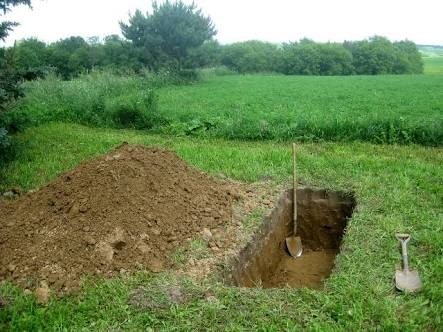
11. The depth of the grave should be at least half the height of the person. It should not be more than his height. The length of the grave should be according to his height. The incised-grave is better than the trench-grave. However, if the ground is very soft and there is a fear of the grave collapsing, the incised-grave should not be dug.
12. If the incised-grave cannot be dug, it is also permissible to place the deceased in a box irrespective of whether the box is of wood, stone or steel. However, it is preferable to spread some sand in the bottom of the box.
13. Once the grave is ready, the deceased should be lowered into the grave from the direction of the qiblah. The method of this is that the deceased should be placed towards the qiblah, and those who are going to lower him should stand facing the qiblah. They should then lift the deceased and lower him into the grave.
14. It is not sunnah to have an odd number of people to place the deceased into the grave. Four people had lowered Rasulullah sallallahu alayhi wa sallam into his grave.
15. At the time of placing the deceased, it is mustahab to recite:
بِسْمِ اللّٰهِ وَعَلٰي مِلَّةِ رَسُولِ اللّٰه
16. After placing the deceased into the grave, it is mustahab to turn him with his right side facing the qiblah.
17. After placing the deceased into the grave, those strings which were used to tie both ends of the kafanshould be loosened.
18. The deceased should then be covered with unbaked bricks or straw. It is makruh to cover him with baked bricks or strips of timber. However, if the ground is very soft and there is a fear of the grave collapsing, it will be permissible to place baked bricks or strips of timber, or even to place him into a box.
19. At the time of placing a woman in the grave, it is mustahabto cover the grave with a sheet. If there is a fear that the body of the deceased will get exposed, it will be wajib to cover the grave with a sheet.
20. Covering the grave with a sheet should not be done when placing a man in the grave. But if there is an excuse, e.g. it is raining or snowing or the sun's rays are very intense, then it will be permissible to do so.
21. Once the deceased has been placed in the grave, whatever soil that came out when digging that grave should be replaced into it. It is makruh to put too much of extra soil to the extent that it is more than one span in height. But if it is not too much, it will not be makruh.
22. It is mustahab to start from the head side when throwing sand over the grave. Each person should throw the soil with both his hands. The first time that he throws, he should read
مِنْهَا خَلَقْنَاكُمْ
the second time he should read:
وَفِيْهَا نُعِيْدُكُمْ
and the third time he should read:
وَمِنْهَا نُخْرِجُكُمْ تَارَةً أُخْرٰي
23. After the burial, it is mustahab to stand near the grave for a little while, make dua of forgiveness for the deceased, or to recite the Quran and send the rewards of this to the deceased.
24. After covering the grave with soil, it is mustahab to sprinkle a little water over it.
25. The deceased should not be buried in a house irrespective of whether he is big or small. This is because this is a speciality of the Prophets alayhimus salaam.
26. It is makruh to make a square grave. It is mustahab to have it in a mound, like the shape of a camel's back. It's height should be equal to one span or slightly higher.
27. It is makruh-e-tahrimi to have the grave very much higher than one span. It is makruh to plaster or cement the grave.
28. It is haraam to construct a dome over the grave for the purpose of decoration. If this is done in order to strengthen the grave, then it will be makruh. It is permissible to write something on the grave of the deceased as a means of remembrance. This is on the condition that there is some necessity, if not, it will not be permissible. But these days, since people have corrupted their beliefs and habits, then due to these harms even those things that are permissible become prohibited. Therefore, things of this sort will not be permissible in any way. Whatever needs or excuses they may offer are nothing but a delusion of their desires, and they themselves know this.
End of series
